

Cabochon vs Faceted: How Gemstone Cuts Change the Story of a Piece
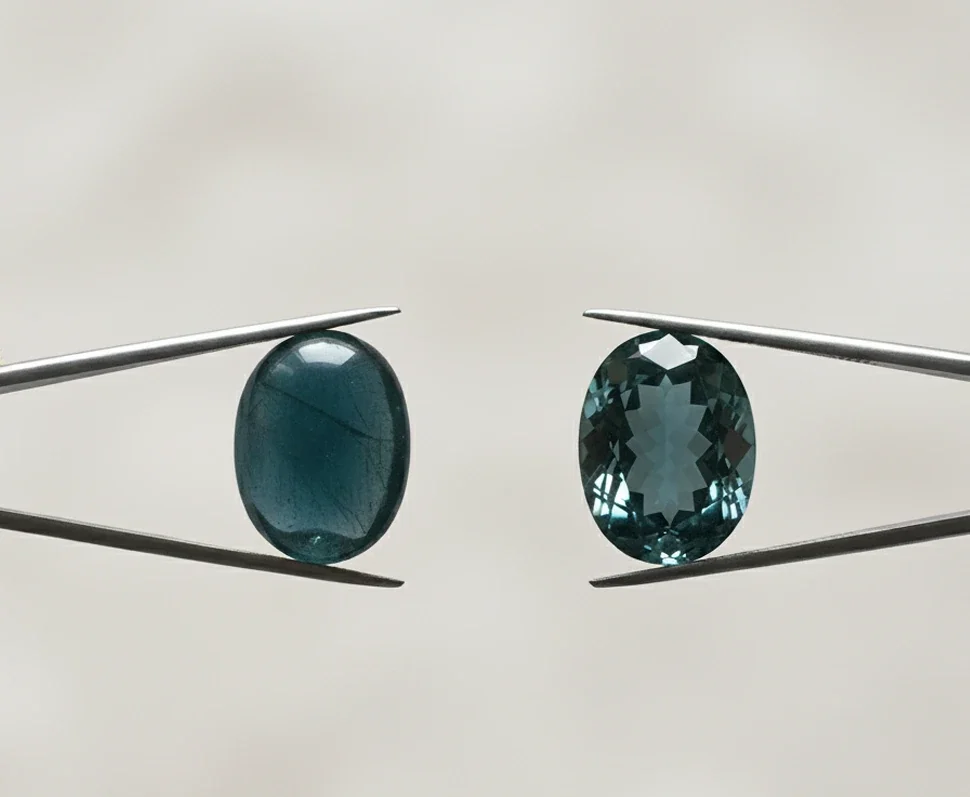
When people first start learning about gemstones, they often assume that sparkle is the ultimate goal. Brilliance, fire, and reflection are what most jewellery marketing emphasises.
Yet some of the most expressive, timeless, and emotionally resonant jewellery contains no facets at all.
This is where the conversation between cabochon and faceted gemstones begins.
Understanding the difference between these two cuts is not about deciding which is better. It is about understanding how a gemstone communicates, how it behaves in light, and how design should follow the stone rather than force the stone into a predetermined aesthetic.
What Is a Cabochon?
A cabochon is a gemstone that has been smoothly polished into a domed shape, without facets.
The surface is continuous and rounded, allowing light to move softly across the stone rather than bouncing sharply from plane to plane. Instead of sparkle, a cabochon offers glow, depth, and presence.
Historically, cabochons were the earliest gemstone cuts. They were favoured long before precision faceting tools existed and were prized for their ability to reveal a stone’s natural character rather than impose symmetry.
Today, cabochons are chosen intentionally, not nostalgically.
They highlight:
colour saturation
internal movement
surface phenomena such as silk, stars, or sheen
a sense of calm and substance
What Is a Faceted Gemstone?
A faceted gemstone is cut with multiple flat surfaces, known as facets, arranged to reflect and refract light.
Faceting is designed to maximise brilliance, contrast, and sparkle. Light enters the stone, bounces internally, and returns to the eye in flashes.
This cut is most commonly associated with diamonds, but many coloured gemstones are also faceted to enhance brightness and clarity.
Faceted stones tend to communicate:
precision
brilliance
structure
classic fine jewellery aesthetics
They are often chosen when the goal is visual impact and light performance.
The Real Difference Is Not Sparkle vs No Sparkle
At a surface level, cabochon vs faceted appears to be a debate between sparkle and softness. In reality, the difference is much deeper.
A cabochon reveals how a gemstone exists internally.
A faceted cut reveals how a gemstone interacts with light externally.
Neither approach is superior. Each tells a different story.
At Layaz, the guiding principle is simple:
design always follows the stone, not the other way around.
Why Some Gemstones Are Better as Cabochons
Not every gemstone benefits from faceting.
Some stones have:
visible inclusions with character
internal silk or clouds
colour zoning
optical phenomena that disappear when faceted
In these cases, faceting can strip the stone of what makes it special.
Cabochon cuts are often preferred for gemstones where:
colour depth matters more than brilliance
internal features add beauty rather than detract
surface effects are present
Examples include certain sapphires, moonstone, opal, jade, turquoise, and stones with star or cat’s-eye effects.
In bespoke jewellery, choosing a cabochon is often a decision to honour the stone as it is, rather than forcing it to behave like a diamond.
Why Faceting Works Best for Other Stones
Some gemstones thrive when faceted.
Stones with:
high transparency
strong refractive properties
clean internal structure
benefit from faceting because it amplifies their natural brilliance.
Diamonds are the most obvious example, but faceting is also ideal for sapphires, rubies, emeralds (when clarity allows), alexandrite, and tanzanite.
In these stones, faceting:
enhances brightness
improves light return
creates contrast and structure
Faceted cuts suit designs where sparkle and precision are central to the aesthetic.
Cabochon vs Faceted in Jewellery Design
The choice between cabochon and faceted cuts affects far more than appearance.
It influences:
how high the stone sits
how the jewellery feels on the hand
how light behaves across the piece
the overall mood of the design
Cabochons often sit lower and feel more grounded. Faceted stones may sit higher to allow light entry and reflection.
This makes cut choice inseparable from lifestyle and wearability considerations.
Which Cut Is Better for Daily Wear?
This is a common question, especially for engagement rings and everyday jewellery.
Cabochons:
tend to sit lower
are less prone to snagging
hide minor scratches more gracefully
feel softer in presence
Faceted stones:
offer more sparkle
may require higher settings
can show wear on facet junctions over time
Neither is inherently fragile when designed properly. What matters is how the setting supports the cut.
Choosing Between Cabochon and Faceted: A Simple Framework
Rather than asking which is better, consider what you are drawn to.
Choose a cabochon if you value:
depth over brilliance
calm, sculptural presence
individuality and character
a more contemporary or artistic expression
Choose a faceted stone if you value:
sparkle and contrast
classic fine jewellery language
light performance
symmetry and structure
Both choices are valid. They simply speak differently.
Case Study: Auckland Cabochon Ring
An Auckland-based client was drawn to the colour and internal texture of a natural sapphire but found that faceted versions felt too sharp and formal.
After reviewing the stone in person, a cabochon cut was chosen. The final ring had a softer silhouette, with the stone sitting low and glowing rather than sparkling.
The result felt modern, intentional, and deeply personal, reflecting the client’s preference for subtlety over brilliance.
Case Study: Hamilton Virtual Consultation With a Faceted Stone
A Hamilton-based client commissioned an engagement ring through virtual consultation and wanted a gemstone that felt classic and luminous.
A faceted sapphire was selected for its brightness and clean structure. CAD renders and a replica model allowed the client to visualise how the facets interacted with light before production began.
The finished ring balanced traditional brilliance with bespoke proportions, proving that faceted stones can still feel personal when designed thoughtfully.
Why Bespoke Jewellery Makes This Choice Easier
In ready-made jewellery, the cut is often chosen first and the design forced around it.
In bespoke jewellery, the process is reversed.
At Layaz:
the gemstone is evaluated first
its natural characteristics guide the cut
the cut informs the setting
the setting supports the stone
This ensures the final piece feels resolved rather than imposed.
Cabochon vs Faceted Is Not a Trend Decision
Trends favour sparkle at times and softness at others. But cut choice should never be trend-driven.
It should reflect:
how you wear jewellery
what resonates emotionally
how you want a piece to feel over time
Cabochon and faceted stones have existed side by side for centuries. Their relevance has never depended on fashion cycles.
Letting the Stone Speak
The most compelling jewellery does not shout. It communicates quietly.
Whether through the glow of a cabochon or the brilliance of a faceted stone, what matters is coherence between material, cut, and design.
When design follows the stone, the result feels inevitable rather than forced.
That is the difference between jewellery that decorates and jewellery that endures.
