
Can Old Jewellery Be Reused or Melted? What You Need to Know Before Deciding
It is a question many people quietly ask when they open a jewellery box filled with pieces they no longer wear.
Can this be reused, or should it be melted down?
Old jewellery often carries more than just material value. It may represent family history, past relationships, or important moments in life. At the same time, if it is never worn, it begins to feel disconnected from the present.
This is where the decision becomes difficult.
Understanding whether jewellery can be reused or melted is not just about what is possible. It is about choosing the option that preserves both value and meaning.
It is a question many people quietly ask when they open a jewellery box filled with pieces they no longer wear.
Can this be reused, or should it be melted down?
Old jewellery often carries more than just material value. It may represent family history, past relationships, or important moments in life. At the same time, if it is never worn, it begins to feel disconnected from the present.
This is where the decision becomes difficult.
Understanding whether jewellery can be reused or melted is not just about what is possible. It is about choosing the option that preserves both value and meaning.
What Reusing Jewellery Actually Involves
Jewellery reuse is often part of a broader redesign process.
This can include:
repolishing precious metals to restore their finish
repolishing gemstones to improve brilliance
custom cutting gemstones to refine shape and light performance
resetting stones into a new design
combining multiple pieces into one cohesive piece
incorporating new natural gemstones where needed
The original jewellery becomes a resource rather than a limitation.
Why Reuse Is Often the Better Starting Point
Reusing jewellery allows you to preserve what matters most.
Instead of losing the piece entirely, you retain:
sentimental value
gemstone character
material worth
At the same time, you gain a design that reflects your current style and lifestyle.
For many people, this is the moment where jewellery becomes wearable again.
Can Jewellery Be Melted Down?
Yes, but with some important considerations.
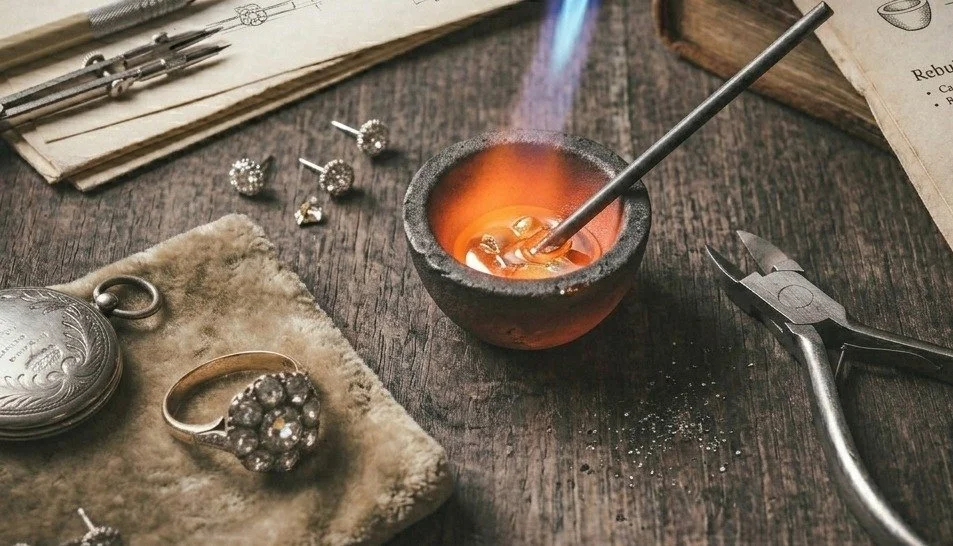
Gold jewellery can be melted and reused to create a new piece. This process involves refining the metal and recasting it into a new form.
However, melting is not always the first or best option.
What Happens When Jewellery Is Melted
When jewellery is melted:
gemstones are removed beforehand
the metal is heated and reformed
small material losses can occur during the process
the metal composition may need adjustment depending on the final design
While the gold itself remains valuable, the original form and structure are permanently lost.
When Melting Jewellery Makes Sense
Melting can be appropriate when:
the original design has little sentimental value
the gemstones are not suitable for reuse
the metal weight is significant
multiple pieces are being consolidated into one
In these cases, melting becomes a practical way to reuse material.
When You Should Not Melt Jewellery
There are situations where melting is not the best choice.
These include:
jewellery with strong sentimental meaning
pieces containing high-quality natural gemstones
designs that could be transformed through redesign
heirloom jewellery that carries family history
Once jewellery is melted, the original piece cannot be recovered.
This is why the decision should be made carefully.
Reuse vs Melt: How to Decide
The decision between reusing and melting jewellery is not always obvious.
A better way to approach it is to ask the right questions.
1. Does the Jewellery Have Sentimental Value?
If the answer is yes, reuse is often the better path.
Keeping even a small part of the original piece allows the story to continue.
2. Are the Gemstones Worth Preserving?
Natural gemstones, especially sapphires, rubies, emeralds, and diamonds, often hold long-term value and uniqueness.
These stones can be reset or custom cut into a new design rather than discarded.
3. Is the Design the Problem, Not the Materials?
In many cases, jewellery becomes unworn because the design feels outdated, not because the materials lack value.
If this is the case, redesign offers a far better solution than melting.
4. Can Multiple Pieces Be Combined?
Several smaller pieces of jewellery can often be combined into one meaningful design.
This approach allows multiple histories to come together in a single piece.
The Layaz Approach: Decide First, Then Design
At Layaz, the process begins with a simple principle.
Do not start with melting. Start with understanding.
Every piece of jewellery is evaluated before any decision is made. The focus is on:
identifying valuable gemstones
assessing metal quality
understanding sentimental significance
exploring redesign possibilities
Only after this evaluation is the best path chosen.
This ensures that value is preserved rather than lost.
What Layaz Jewellery Redesign Can Do
Because Layaz works entirely in house, jewellery can be transformed in ways that go beyond simple adjustments.
This includes:
repolishing metals and gemstones
custom cutting gemstones to improve brilliance
resetting stones into new designs
melting gold when appropriate
combining multiple pieces into one
adding new natural gemstones where needed
The goal is not to change jewellery for the sake of it, but to create something that feels right to wear.
The Jewellery Redesign Process
Jewellery reuse and transformation follow a structured process.
Consultation
A 45-minute consultation is available Monday to Sunday from 9am to 7pm, either in person or virtually.
Clients from Auckland suburbs such as Remuera, Parnell, Ponsonby, Herne Bay, and Newmarket often visit in person, while others connect from Tauranga and across New Zealand.
Design Stage
Within 2 to 3 working days, design options and pricing guidance are provided.
Replica Model
An exact replica model is created so clients can visualise the design before production begins.
Crafting Stage
For redesign projects, crafting typically takes 6 to 8 weeks, depending on complexity.
Full Approval Process
Clients approve each stage before moving forward.
If the final piece does not meet expectations, Layaz will remake it at no additional cost.
Case Study: Auckland Client Who Planned to Melt Everything
An Auckland client initially wanted to melt several inherited pieces into a single new ring.
After evaluation, it became clear that the gemstones were high quality and worth preserving.
Instead of melting everything, the stones were reset into a refined design while only part of the gold was reused.
The result retained both material and sentimental value.
Case Study: Tauranga Client Who Combined and Reused Materials
A Tauranga client had multiple pieces of jewellery that had been sitting unworn for years.
Rather than selling or discarding them, the gold was partially melted and the gemstones were reused in a single pendant design.
This approach allowed both materials and meaning to be preserved.
Why Reuse Often Creates More Value Than Melting
Melting focuses on material value.
Reuse focuses on total value.
Total value includes:
sentimental meaning
gemstone uniqueness
design relevance
long-term wearability
For many people, this broader view leads to better decisions.
A More Thoughtful Way Forward
Old jewellery does not need to remain unused or be reduced to raw material.
With the right approach, it can become something meaningful again.
The key is not choosing between reuse and melting too quickly, but understanding what is possible before making that decision.
